
High Quality Ceramic vs Cheap Mugs: What to Buy
Table of Contents
- High Quality Ceramic vs Cheap Mugs: The Key Differences at a Glance
- How to Tell If a Ceramic Mug Is High Quality
- Are Cheap Ceramic Mugs Microwave Safe? Safety and Leaching Risks
- Heat Retention and the Flavor of Your Coffee
- Best Ceramic Mugs for Daily Coffee: What to Look For
- The Hidden Cost of Cheap Mugs: Chip Resistance and Thermal Shock
- Which Should You Buy?
- Frequently Asked Questions
Last Updated: September 4, 2026
High Quality Ceramic vs Cheap Mugs: The Key Differences at a Glance
The difference between a high quality ceramic and a cheap mug isn't just about price; it comes down to material science, safety, and how the mug survives daily use. A premium mug is fired at higher temperatures, making the clay denser and less porous, which directly affects heat retention, flavor neutrality, and durability. Cheap mugs often skip these steps to cut costs, leaving you with a vessel that may harbor bacteria, leach glaze chemicals, or crack under thermal stress. This guide from Midland Mugs breaks down exactly what separates the two so you can buy with confidence.
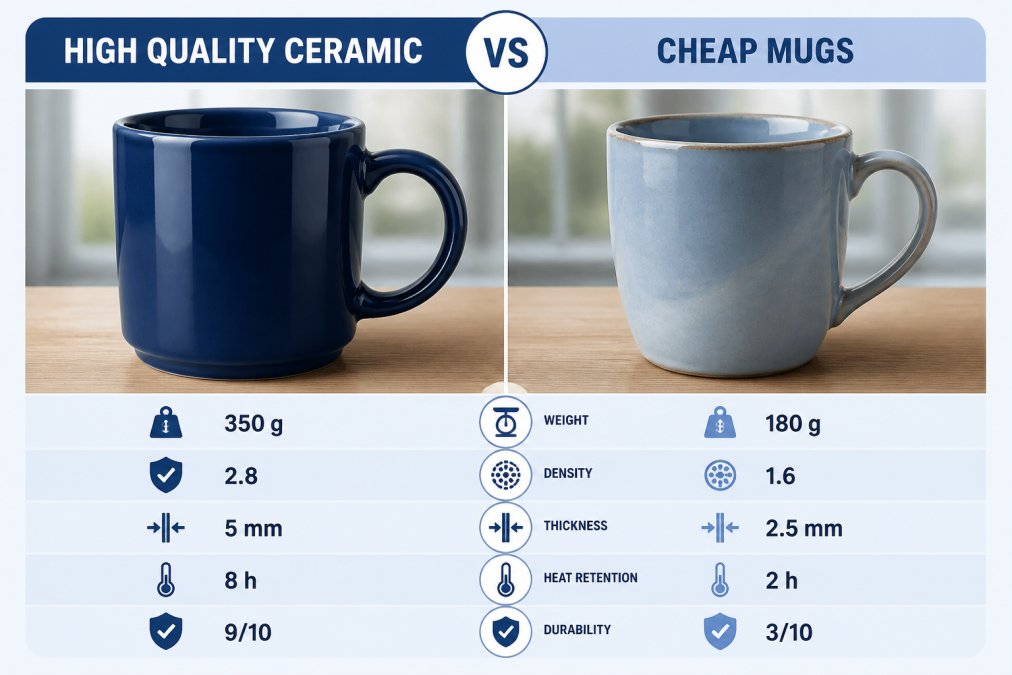
Most guides focus on aesthetics, but the real story is in the manufacturing process. A truly high quality ceramic mug is kiln-fired at temperatures above 1200°C, a process called vitrification that fuses the clay particles into a glass-like, non-porous surface (ceramics.org). Cheap mugs, often mass-produced at lower temperatures, remain porous and brittle, which is why they chip easily and absorb stains and odors over time.
| Feature | High Quality Ceramic | Cheap Mug |
|---|---|---|
| Firing Temperature | High (vitrified) | Low (porous) |
| Porosity | Low, non-porous | High, absorbs liquids |
| Chip Resistance | High | Low |
| Thermal Shock Resistance | High | Low |
| Glaze Safety | Food-grade, lead-free | Often unverified |
| Weight | Dense, substantial | Light, thin-walled |
| Print Durability | Fired or cured, long-lasting | Fades or chips quickly |
How to Tell If a Ceramic Mug Is High Quality
A high quality ceramic mug feels dense and substantial in your hand, with a smooth, glass-like glaze and a clean, unblemished rim. Flip it over; the unglazed foot ring should feel fine-grained and smooth, not rough or chalky. If it looks, feels, and sounds like stone rather than terracotta, you are holding a properly fired piece.
Firing Temperature, Vitrification, and Porosity
The single biggest difference between a high quality ceramic mug and a cheap one is the firing temperature. Vitrification is the process where clay is heated until it becomes glass-like and non-porous; without it, your mug is essentially hardened mud. A simple test is to hold the mug up to the light or listen for a clear, ringing "ping" when you flick it, which indicates high density and low porosity. Low-porosity ceramic is crucial because it means the mug won't absorb coffee oils, harbor bacteria, or develop a stale smell over time.
Weight, Glaze Finish, and Print Durability
Quality is immediately apparent in weight; a high quality ceramic mug has thick, dense walls that retain heat, while cheap mugs feel feather-light and thin. Examine the glaze under bright light: high quality ceramic has a smooth, uniform finish without pinholes, bubbles, or "crazing" (fine cracks), which can harbor bacteria. The print is another giveaway; a cheap mug's design often fades or chips off within a few washes, whereas a durable print is either fired into the glaze or cured with a food-safe coating that withstands daily dishwasher use. At Midland Mugs, every mug is crafted from premium ceramic with durable, long-lasting prints.
Are Cheap Ceramic Mugs Microwave Safe? Safety and Leaching Risks
Cheap ceramic mugs are often not microwave safe, and using them can expose you to harmful substances leaching into your coffee. The primary risk comes from the glaze, which on low-quality mugs may contain lead or cadmium to achieve bright colors at a lower cost (the FDA). When heated, these heavy metals can migrate into your beverage, a risk documented by food safety authorities. Look for mugs explicitly labeled "lead-free" and "cadmium-free" or those that have passed independent safety testing; reputable manufacturers like Midland Mugs have their products tested to guarantee they are safe for microwave and dishwasher use.
Heat Retention and the Flavor of Your Coffee
A high quality ceramic mug keeps your coffee hot for noticeably longer, and crucially, it doesn't interfere with the taste. The dense walls of a vitrified mug act as an insulator, slowing heat loss so your last sip is as warm as your first. More important for purists is flavor neutrality; a non-porous surface means the mug won't absorb the bitter oils from previous brews or impart a "clay" taste to your drink.
Cheap mugs, by contrast, are often the culprit behind lukewarm coffee and stale flavors. Their thin, porous walls let heat escape rapidly, and they absorb residual coffee oils that go rancid, tainting every subsequent cup. If you've ever wondered why coffee tastes better at a cafe, the ceramic quality of the cup is a significant factor. This is why many coffee enthusiasts choose a high quality ceramic mug for daily use, as it preserves the integrity of the brew from the first pour to the last drop.
Best Ceramic Mugs for Daily Coffee: What to Look For
When choosing the best ceramic mugs for daily coffee, prioritize safety certifications, vitrified ceramic, and a durable, food-safe print. These three factors ensure the mug is safe, long-lasting, and looks great for years, not just weeks. For a daily driver, you also want a comfortable handle and a capacity that suits your caffeine habit, whether that's a standard 11oz or a larger 17oz for lattes.
The Midland Mugs collection is built around these principles. The Breve Coffee Ceramic Latte Mug offers a large 17oz capacity with a durable, premium ceramic build, perfect for those who want their coffee to stay hot through a long morning. For a standard daily cup, the Aquarius Zodiac Ceramic Mug or the playful Ceramic Sad Emoji Mug provide a vibrant, glossy finish with prints that are tested to retain their quality in microwaves and dishwashers. Each mug is designed to be a durable, long-lasting choice for home or office, addressing the common complaint about prints fading after a few washes.

The Hidden Cost of Cheap Mugs: Chip Resistance and Thermal Shock
The real expense of a cheap mug isn't the purchase price; it's the frustration of chips, cracks, and sudden breakage. A cheap mug has poor chip resistance due to its low firing temperature and brittle structure, meaning a single knock against the sink can leave a permanent flaw. More concerning is thermal shock, which occurs when a mug is subjected to a rapid temperature change, like pouring boiling water into a cold mug or moving it from the fridge to the microwave. High quality ceramic, with its dense, vitrified body, is designed to withstand these stresses without cracking.
The Physics of Thermal Shock: Why Cheap Mugs Crack
Thermal shock isn't random bad luck, it's a predictable failure of material science. When a mug is heated rapidly, the outer surface expands faster than the interior. This differential expansion creates internal stress. In a vitrified mug fired above 1200°C, the clay particles have fused into a continuous glassy matrix with a uniform coefficient of thermal expansion. The stress distributes evenly across the body, and the mug absorbs the energy without fracturing.
A cheap mug, fired at lower temperatures, retains microscopic air pockets between its clay particles. These pockets act as stress concentrators. When the outer wall expands against the cooler interior, the air pockets create weak points where cracks initiate. The result is the characteristic "ping" of a crack forming, often minutes after the pour, when the mug has had time to equilibrate. This is why cheap mugs fail catastrophically, while high-quality mugs survive decades of thermal cycling.
The Manufacturing Process: Slip-Cast vs. Kiln-Fired
The difference in thermal resilience begins long before the mug reaches your kitchen. Cheap mugs are typically mass-produced using slip-casting, where liquid clay (slip) is poured into plaster molds. This process is fast and cheap, but it introduces inconsistencies: the slip may contain air bubbles, the mold may compress the clay unevenly, and the resulting walls often have variable thickness. When a mug has a thick base and thin walls, the differential expansion during heating is more pronounced, making it structurally unsound.
High-quality ceramic mugs, by contrast, are often either jiggered (thrown onto a spinning mold) or hand-thrown, processes that align the clay particles and produce uniform wall thickness. They are then fired slowly in a controlled kiln cycle, allowing moisture to escape gradually before vitrification begins. A common pattern in artisanal production is a two-stage firing: a bisque fire to harden the clay, followed by a glaze fire at a higher temperature. This second firing, often above 1200°C, is what transforms the body into a non-porous, thermal-shock-resistant vessel. Cheap mugs often skip the bisque fire or combine both stages into a single, faster cycle to save energy costs, sacrificing structural integrity in the process.
The 20°C Rule: A Practical Test
Most ceramic engineers use a simple benchmark: a well-made mug should survive a temperature differential of at least 150°C (270°F) without cracking (sciencedirect.com). That's the difference between a freezer at -18°C and boiling water at 100°C. To test your own mugs safely, place a dry mug in a preheated oven at 200°C (392°F) for 15 minutes, then remove it and immediately place it on a dry wooden board at room temperature. A high-quality vitrified mug will survive this thermal shock. A cheap mug will likely crack or shatter within seconds. This test is destructive, so don't perform it on mugs you care about, but it's a revealing demonstration of why cheap mugs fail in real-world use.
Which Should You Buy?
Buy a high quality ceramic mug if you value a safe, durable vessel that keeps your coffee hot and tastes clean, and you are tired of replacing chipped or faded mugs. Choose a cheap mug only if you need a temporary, disposable option and don't mind the risks of leaching, poor heat retention, and short lifespan. For daily coffee drinkers, gift-givers, and anyone who wants a mug that looks as good in a year as it does today, high quality ceramic is the clear winner.
Choosing between high quality ceramic vs cheap mugs ultimately comes down to understanding what you are actually paying for: safety, durability, and a better coffee experience. Midland Mugs crafts every mug from premium ceramic with vibrant, long-lasting prints, backed by independent safety testing for your peace of mind. Whether you are buying a personalized gift or equipping your office, our collection offers durable, dishwasher-safe options that don't compromise on style or quality. Get started with Midland Mugs and make every sip special with a mug built to last.
Frequently Asked Questions
What is the healthiest material for coffee mugs?
High-fired ceramic and glass are the healthiest choices. Ceramic fired at high temperatures becomes vitrified, making it non-porous and resistant to harboring bacteria. Crucially, you need a glaze that is lead-free and cadmium-free. Cheap, low-fired mugs may have porous bodies or unstable glazes that can leach metals into hot, acidic drinks. Look for brands that state their product safety tests are conducted, which confirms the glaze is food-grade and safe for daily use.
What are the downsides of using ceramic mugs?
The main downsides are weight and brittleness. Ceramic mugs are heavier than glass or plastic options, which can matter for travel or weak wrists. They also chip or break if dropped. Lower-quality ceramic is more prone to chipping because it is fired at lower temperatures, making it less dense. High-quality ceramic is more durable, but you should still hand-wash it if you want to protect the rim and print. Stop using any mug once it develops a crack or chip, as bacteria can hide there.
Does the quality of ceramic affect the taste of coffee?
Yes, it does, although it is mostly about heat retention and cleanliness. A high-quality, dense ceramic mug holds heat longer, keeping your coffee at the right temperature for more sips. Cheap, porous mugs can absorb odors and residual flavors from previous drinks, especially if the glaze is compromised. A clean, non-porous surface with a stable, food-grade glaze is flavor-neutral. It will not add any off-tastes, allowing the coffee's true profile to come through.
When should you stop using a chipped ceramic mug?
You should retire a chipped or cracked mug immediately. The chip exposes the porous clay body beneath the glaze. This area can absorb coffee, harbor bacteria, and is difficult to clean thoroughly. Worse, the crack can expand when you pour in hot liquid, potentially causing the mug to break in your hands. If the chip is on the rim, you also risk cutting your lip. A chipped mug is a sign that the structural integrity of the ceramic is compromised, so it is time to replace it.
This article was written using GrandRanker