
Why Premium Ceramic Mugs Cost More (2026 Guide)
Table of Contents
- The Real Cost of Handmade Pottery vs. Mass Production
- Material Quality: Why Premium Ceramic Mugs Start With Better Clay
- Kiln Firing and Energy Costs: The Hidden Expense
- Ceramic Mug Durability and Heat Retention: What You're Actually Paying For
- How to Care for Custom Ceramic Mugs to Protect Your Investment
- Choosing the Best Ceramic Mugs for Daily Coffee
- Conclusion: Justifying the Price of Artisan Craftsmanship
- Frequently Asked Questions
Last Updated: September 7, 2026
The Real Cost of Handmade Pottery vs. Mass Production
When you hold a handmade mug, you can feel the difference before you even take a sip, the weight, the glaze texture, the subtle irregularities. That tactile experience explains why premium ceramic mugs cost more than factory-made options, and it comes down to something simple: time.
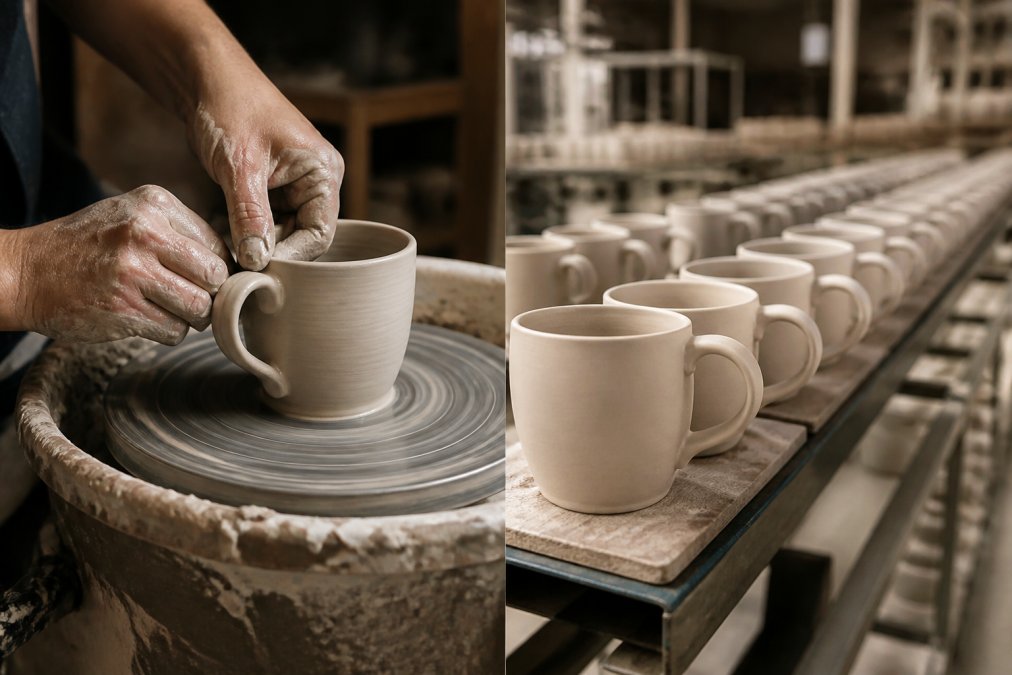
A single handmade mug can take days to complete, not minutes. While a mass-production line can churn out hundreds of identical pieces in an hour, a potter spends that same hour throwing, trimming, and refining just a handful of forms.
Consider the economics of scale. A machine produces a mug for pennies in materials and seconds in labor. A skilled potter, by contrast, pays for years of training, hours of focused work, and the risk of kiln failures that can ruin entire batches. The American Craft Council's analysis of craft economics notes that handmade goods carry embedded labor costs that industrial processes simply do not have. You are not just buying a vessel for coffee; you are buying thousands of hours of accumulated skill.
Labor, Skill, and the Human Touch
The journey from a lump of clay to a finished mug is long and unforgiving. Throwing the cylinder takes minutes, but mastering the even wall thickness that prevents warping takes years. Trimming the foot requires precision. Applying glaze without drips or bare spots is a skill in itself.
Production time for a single quality mug is rarely measured in minutes. Between throwing, trimming, bisque firing, glazing, and glaze firing, a potter might invest several hours of active work across multiple days, before accounting for pieces that crack, warp, or blister in the kiln, a hidden cost built into the final price of every mug that survives.
Material Quality: Why Premium Ceramic Mugs Start With Better Clay
All clay is not created equal. The clay body is the fundamental determinant of a mug's performance, dictating its durability, thermal behavior, and even its food safety.
The Mineralogy of the Mug: Stoneware vs. Porcelain vs. Earthenware
Ceramic clays are broadly categorized by their mineral composition and the temperature at which they vitrify, the point where silica and feldspar melt to fill the pores between clay particles.
- Earthenware: Fired at lower temperatures (around 1,000-1,150°C), earthenware remains porous. Its body is typically composed of more iron and calcium, which lowers the melting point but leaves microscopic channels. Unless sealed with a glassy glaze, earthenware will absorb water, harbor bacteria, and fail under thermal stress. This is why cheap, souvenir-style mugs often feel 'chalky' on the unglazed foot ring.
- Stoneware: Fired between 1,200-1,300°C, stoneware begins to vitrify. The feldspar content melts, filling the voids between the clay particles. This process reduces water absorption to below 3%, creating a denser, harder surface. The higher iron content gives stoneware its characteristic warm, earthy tones.
- Porcelain: Fired at even higher temperatures (1,250-1,400°C), porcelain is formulated with kaolin, a pure white clay, and feldspar. It vitrifies to a near-glass state, achieving water absorption rates of less than 0.5%. This is why porcelain mugs feel distinctly 'ringing' when tapped, the body is so dense it resonates like a bell.
The Cost of Formulation and the 'Recipe'
A premium mug is not just a single clay dug from the ground; it is a carefully engineered composite. Artisan producers often blend clays to achieve a specific plasticity and thermal expansion rate to match the glaze, rejecting any body that would cause the glaze to craze after firing.
This formulation process is a hidden cost. A potter might test dozens of clay bodies before finding one that is both forgiving on the wheel and durable in the kiln, with each test batch consuming materials and kiln space.
The Glaze: A Glassy Armor, Not Just a Color
The glaze is not merely a decorative coating; it is a glass layer that seals the clay body. The chemistry of the glaze must be 'fit' to the clay: if it shrinks more during cooling, it will craze, creating tiny cracks that allow moisture and bacteria to penetrate; if it shrinks less, it can 'shiver' and pop off the edge.
Premium mugs often use glazes with a high silica and alumina content for hardness and scratch resistance, formulated to be food-safe without heavy metals like lead or cadmium. The firing schedule for these glazes is also more demanding, requiring a slow, controlled cooling phase to form a stable, stress-free matrix.
The Cost of Raw Materials vs. The Cost of Consistency
The raw clay itself is not the primary cost driver. The real expense is in the consistency of the material. Artisan studios pay a premium for smaller, carefully processed batches that guarantee the same firing behavior every time, as a single batch with inconsistent iron oxide distribution can ruin an entire firing load.
Kiln Firing and Energy Costs: The Hidden Expense
Firing is where the real money burns. A mug typically goes through two firings, bisque and glaze, both requiring the kiln to reach extreme temperatures, often exceeding 1,200 degrees Celsius, and to hold those temperatures for hours. The firing cycle alone can take a full day or more.
The energy required to run a kiln is substantial, and kiln maintenance adds another layer of cost. Elements burn out, thermocouples drift, and shelves and posts slowly degrade. A potter must also manage the risk of a firing cycle going wrong, which can destroy an entire kiln load of work, costs distributed across every piece produced.
Ceramic Mug Durability and Heat Retention: What You're Actually Paying For
When you invest in a high-quality ceramic mug, you are paying for performance you can measure. The claims of 'better heat retention' and 'more durable' are often vague marketing speak. To understand the true value, you need to look at the physics of thermal mass and the mechanics of failure.
The Physics of Heat Retention: Mass, Density, and Specific Heat
Heat retention in a mug is not a simple matter of 'thicker walls.' It is a function of three variables: the specific heat capacity of the ceramic, the density of the body, and the total thermal mass.
- Specific Heat Capacity: This is the amount of energy required to raise the temperature of 1 gram of material by 1°C. Dense, vitrified ceramics have a higher specific heat capacity than porous, low-fired clay, meaning a high-fired stoneware mug can absorb and hold more thermal energy before it reaches equilibrium with the coffee.
- Thermal Mass: A mug with a thicker wall and a denser body has more mass. When you pour hot coffee into a thin, cheap mug, the mug quickly reaches the coffee's temperature and then immediately starts radiating that heat into the air. A dense, thick-walled mug acts as a thermal reservoir, absorbing the initial heat but releasing it slowly, keeping the coffee at a drinkable temperature for a longer period. This is why a 400-gram stoneware mug will keep coffee hot for 30-40 minutes, while a 200-gram earthenware mug might lose the heat in 15 minutes.
- The Role of the Lid: A critical factor often ignored is the surface area exposed to air. A premium mug with a well-designed, slightly tapered shape reduces the surface area of the liquid, slowing evaporative cooling. Some high-end travel mugs use a double-wall construction to create a vacuum, but for a single-wall ceramic mug, the density of the body is the primary insulator.
The Thermal Shock Test: How to Spot a Mug That Will Crack
The most common failure mode for a ceramic mug is thermal shock, cracking caused by rapid temperature changes. The industry standard for testing this is the ASTM C554 standard, which involves cycling a mug from boiling water to cold water repeatedly, a version of which artisan studios often perform on their own work.
A mug that cracks in the dishwasher or when you pour boiling water into it has failed due to thermal stress. The crack occurs because the inner wall expands faster than the outer wall, creating tensile stress. A well-engineered mug has a uniform wall thickness to minimize this stress gradient.
How to test for thermal shock resistance at home:
- Place the mug in a cold oven.
- Turn the oven to 350°F (175°C).
- Once the oven reaches temperature, pour boiling water into the mug.
- If the mug survives this, it is likely to survive normal dishwasher cycles.
The 'Foot Ring' Test: A Sign of Quality Engineering
The foot ring, the unglazed rim on the bottom of the mug, is a window into the maker's process. On a cheap, mass-produced mug, it is often rough, sharp, or has chipped edges.
On a premium mug, the foot ring is ground smooth or wiped clean before firing. A rough foot ring can scratch surfaces, and a sharp edge is a stress concentrator, a tiny chip can propagate into a crack up the side of the mug over time.
The Glaze Fit and Crazing: A Durability Red Flag
Crazing, the network of fine cracks in the glaze, is often seen as a cosmetic flaw, but it is also a durability issue. A crazed glaze means the glass layer is under tension and has fractured, allowing moisture to seep into the clay body and weaken it over time.
A premium mug should have a glaze that is 'compression-fit' to the clay, formulated to shrink slightly less during cooling and put the glaze under slight compressive stress. Since glass is much stronger under compression than tension, a compression-fit glaze is more resistant to chipping and scratching.
The 10-Year Test: Longevity as a Cost Metric
To justify the higher price, consider the cost-per-use over a decade. A $10 mass-produced mug that chips and cracks within 2 years costs you $5 per year. A $45 premium mug that lasts 15 years costs you $3 per year, a better economic decision over the long term.
How to Care for Custom Ceramic Mugs to Protect Your Investment
A premium mug is an investment, and how you care for it determines how long it lasts. Even the toughest stoneware will chip if knocked against a hard surface or cracked by a sudden extreme temperature change. Avoid plunging a cold mug into boiling water or moving it directly from the freezer to a hot oven.
Hand washing is the safest option for preserving both the ceramic body and any custom print. While many high-quality mugs are dishwasher safe, the harsh detergents and high heat can eventually dull glazes and degrade prints over time. For custom ceramic mugs with detailed designs, gentle hand washing with a soft sponge will keep the print vibrant for years. Avoid abrasive scrubbers that can scratch the glaze and create tiny crevices where bacteria can hide.
When stacking mugs, place a soft cloth between them or store them separately to prevent rim chips. These small habits make a significant difference in the lifespan of your mug.
Choosing the Best Ceramic Mugs for Daily Coffee
So how do you choose the best ceramic mugs for daily coffee? Start by considering the weight and feel. A mug that is too thin may not retain heat well, while one that is excessively thick may be unwieldy. Look for a comfortable handle and a base that sits steadily. The glaze should be smooth, free of pinholes, and consistent in color.
Consider the volume. A standard daily coffee mug holds around 350 millilitres, but if you prefer larger servings or a cappuccino with room for milk, look for something in the 400 to 500 millilitre range. Think about the rim. A slightly rolled or rounded rim feels better against the lips than a sharp, thin edge.
For those seeking a personalized touch, custom printing adds another layer of value. A mug that reflects your interests or commemorates a special occasion becomes more than just a vessel; it becomes a personal artifact. Research on the psychological value of personalized goods suggests that items with personal meaning are often treasured and kept longer, reinforcing the value of the initial investment.
| Selection Criterion | What to Look For | Why It Matters |
|---|---|---|
| Clay Body | High-fired stoneware or porcelain | Denser body means better heat retention and durability |
| Weight | Substantial, not feather-light | Indicates density and thicker walls for insulation |
| Glaze Finish | Smooth, consistent, no pinholes | Seals the clay, prevents staining, protects the print |
| Handle Design | Comfortable grip, fits fingers | Prevents drops and makes daily use more pleasant |
| Rim Profile | Rounded or rolled edge | Feels better against the lips and resists chipping |
Conclusion: Justifying the Price of Artisan Craftsmanship
The price of a premium mug is not arbitrary. It reflects the cost of better materials, the energy-intensive firing process, and the irreplaceable human skill required to shape and finish each piece. When you buy handmade, you are also making a choice about sustainability and ethical labor, supporting a craftsperson rather than an anonymous factory. The Craft Council's report on the value of handmade goods highlights how purchasing artisan goods supports local economies and preserves traditional skills.
A mass-produced mug is a commodity, priced for disposal. A premium ceramic mug is a durable good, designed for a daily ritual that can last decades. The higher upfront cost is an investment in longevity, performance, and a one-of-a-kind object that no factory can replicate.
At Midland Mugs, we understand that our premium ceramic mugs offer exceptional value. We craft our mugs with high-quality ceramic materials designed for durability and long-lasting prints, perfect for a personalized gift or a stylish addition to your home or office. When you choose a mug from our collection, you are choosing vibrant designs, fast shipping, and secure packaging that ensures your investment arrives intact. Shop now and find a mug that will elevate your daily coffee ritual for years to come.
Frequently Asked Questions
Why are premium ceramic mugs more expensive than mass-produced ones?
The price difference comes down to materials, labor, and overhead. Mass-produced mugs are cast from liquid clay in molds and fired on conveyor belts, minimizing human input. Premium ceramic mugs often involve skilled potters who throw, trim, and glaze each piece by hand. They also use higher-quality stoneware or porcelain clays and undergo longer, more controlled kiln firings. These factors increase production time and energy costs, but result in a denser, more durable mug with a better finish.
What materials make a ceramic mug higher quality?
The clay body is the foundation. Premium mugs typically use stoneware or porcelain, which are fired at higher temperatures to become vitrified, or glass-like. This makes them less porous, stronger, and more resistant to chipping than low-fire earthenware. The glazes also matter; high-quality glazes are food-safe and formulated to match the clay's thermal expansion, preventing crazing or cracking. This combination of dense clay and compatible glaze is what separates a durable, daily-use mug from a decorative one.
Does the firing process affect the price of a ceramic mug?
Yes, significantly. Firing is energy-intensive and time-consuming. Many premium mugs require at least two firings: a bisque firing to harden the clay and a glaze firing to melt the coating. High-fire stoneware and porcelain need temperatures around 1200-1300°C, which consumes substantial electricity or gas. Kilns also have limited capacity and slow cooling cycles. These energy and time costs are built into the final price of each mug.
Are premium ceramic mugs safer for daily use?
Generally, yes. Premium mugs made from high-fire stoneware or porcelain are vitrified, meaning they absorb very little water. This makes them more hygienic and resistant to bacteria growth compared to porous, low-fire pottery. They are also less likely to harbor mold in tiny cracks. Furthermore, reputable makers use food-safe glazes that are lead-free and cadmium-free. Always check that the mug is labeled food-safe and dishwasher-safe to ensure it meets safety standards.