
How to Ship Fragile Ceramic Mugs Safely: 2026 Guide
Table of Contents
- What You'll Need to Pack Ceramic Mugs
- Best Packaging Materials for Ceramics
- Step-by-Step: How to Ship Fragile Ceramic Mugs Safely
- Double Boxing Method for Fragile Items
- Choosing a Carrier and Cutting Shipping Costs
- Shipping Insurance for Ceramic Goods
- Common Mistakes That Break Mugs in Transit
- Frequently Asked Questions
Last Updated: September 12, 2026
What You'll Need to Pack Ceramic Mugs
Shipping a ceramic mug without it arriving in pieces comes down to three things: cushioning, immobilization, and a box that can take a hit. This guide walks through exactly how to ship fragile ceramic mugs safely, from the first layer of bubble wrap to the final shake test.
Before you tape a single box, gather the right supplies. A mug wrapped in a single sheet of newspaper will not survive a sorting facility.
Here's your packing checklist:
- Corrugated cardboard box, sized 5-8 cm larger than the mug on every side
- Small inner box for double-boxing
- Bubble wrap, at least two layers per mug
- Kraft paper or honeycomb paper for void fill
- Packing peanuts or foam inserts
- Fragile tape and a permanent marker
- Shipping label and tracking number
Royal Mail guidance on packing fragile items
Best Packaging Materials for Ceramics
The best packaging materials for ceramics combine shock absorption with rigidity. Bubble wrap handles the first job. Corrugated cardboard handles the second.
Ceramic breaks because energy from a drop has nowhere to go except through the mug. Cushioning materials absorb that energy before it reaches the ceramic. The stiffer the outer container, the less force transfers inward.
A common mistake is using a thin mailer envelope. Those work for clothing, not pottery.
For the outer layer, double-wall corrugated cardboard outperforms single-wall every time. For void fill, kraft paper and honeycomb paper are lighter than packing peanuts and easier to recycle. Bubble wrap remains the standard for direct contact with the mug because it conforms to curved surfaces and protects the handle.
Step-by-Step: How to Ship Fragile Ceramic Mugs Safely
The full process takes about 10 minutes per mug once you have supplies ready. Skip any step and your breakage risk climbs.
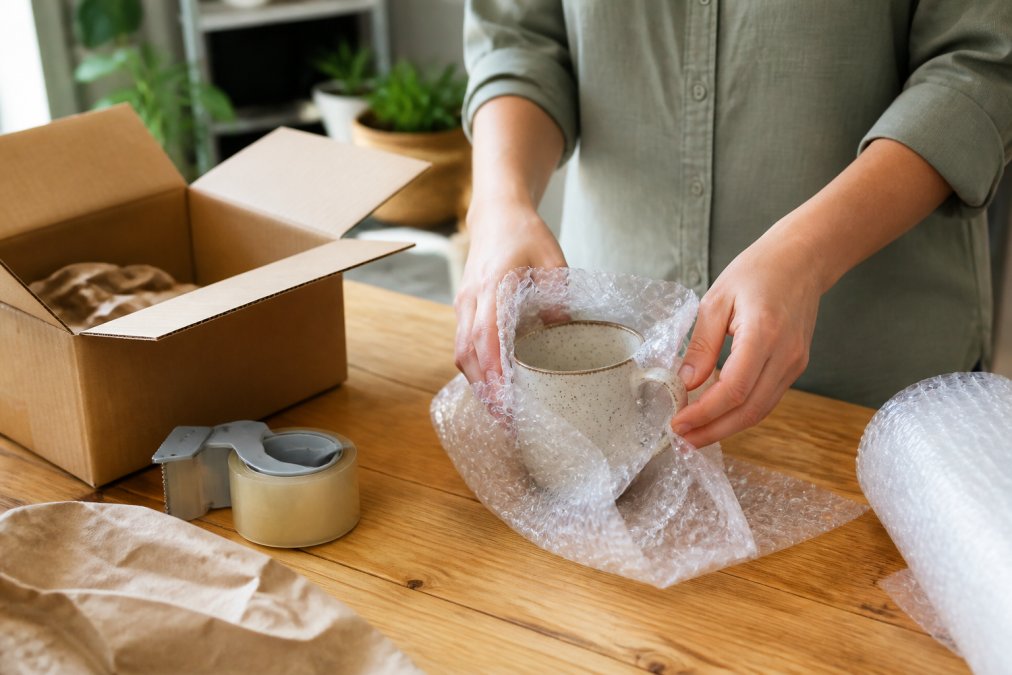
Step 1: Wrap the Mug and Protect the Handle
Wrap the mug in at least two full layers of bubble wrap, bubbles facing inward against the ceramic. The handle is the most vulnerable point, so add an extra strip of bubble wrap or foam around it specifically.
Secure the wrap with tape, but never tape directly onto the mug surface. Tape residue damages glaze and printed designs.
Step 2: Pad the Inner Box and Fill Empty Space
Place the wrapped mug in a smaller inner box with at least 5 cm of cushioning on all sides. Fill every gap with kraft paper, honeycomb paper, or packing peanuts. If you can hear the mug move when you tilt the box, add more void fill.
Padding density matters more than padding volume. A loosely filled box lets the mug shift on every turn.
Step 3: Seal, Label, and Run the Shake Test
Seal the inner box, then place it inside the larger outer box with another 5 cm of cushioning between the two. Seal the outer box with fragile tape on all seams.
Label the box "FRAGILE" on at least two sides with a permanent marker, and attach the shipping label with the tracking number clearly visible.
The Standardized Shake Test Protocol
Most guides tell you to "shake the box and listen." That is not a test, it is a vibe check. A repeatable protocol gives you a pass/fail answer you can trust before you hand the parcel to a carrier.
Equipment: none required beyond the packed box and a flat surface.
Procedure:
- Lift test. Hold the box at chest height and tilt it 45° in each of the four directions (forward, back, left, right). You should feel no internal shift. Any sliding sensation means the inner contents are not immobilized.
-
Shake test. Hold the box with both hands and shake it gently next to your ear, about the force of a light handshake, not a rattle. Listen for:
- Silence → pass. Contents are fully immobilized.
- Soft thud with no rattle → marginal. Add fill until the thud disappears.
- Any rattle, click, or ceramic-on-ceramic sound → fail. Repack before shipping.
- Corner drop test (optional but recommended for high-value mugs). From a height of 30-45 cm, drop the sealed box onto a hard floor, once on a bottom corner and once on a top edge (ista.org). Open the box and inspect. If the mug has shifted or the inner box shows crush damage, add cushioning and repeat.
- Compression check. Press down firmly on the top of the sealed box. The lid should not flex more than a few millimeters. Excessive flex means the void fill is under-packed.
Pass criteria: silence on the shake test, no shift on the tilt test, and no visible deformation on the compression check. If any test fails, add fill and repeat all four steps, do not skip ahead.
Double Boxing Method for Fragile Items
The double boxing method for fragile items uses two boxes with a cushioning layer between them. The inner box holds the wrapped mug. The outer box absorbs impacts during transit. The gap between them acts as a crush zone.
This is the single most effective technique for breakage prevention. A single box gives a drop impact one layer of defense. Double-boxing gives it two, plus a buffer zone that deforms instead of transferring force.
For multiple mugs in one shipment, wrap each mug individually, then pack them in the inner box with dividers or extra padding between each one. Never let two mugs touch directly.
Choosing a Carrier and Cutting Shipping Costs
Carrier choice affects both breakage rates and what you pay, and the two are linked: the heavier and bulkier your packaging, the more you pay, and the more padding you add, the heavier it gets. The trick is finding the point where protection stops improving but cost keeps climbing.
Dimensional weight: the variable most shippers miss
Parcel carriers bill on dimensional weight (DIM weight), which is calculated from the box's length × width × height divided by a carrier-specific divisor. A large, light box gets billed as if it were heavy. In practice, this means an oversized box with a single mug inside can cost more to ship than a smaller, denser box holding three mugs.
A common pattern among small sellers: they buy one box size "to be safe," over-pad it, and pay a DIM-weight penalty on every parcel. Right-sizing the box is the single fastest cost lever.
Weight-to-cost optimization: where the trade-off lives
Every gram of packaging counts against you at the scale. Consider the trade-offs:
- Bubble wrap vs. honeycomb paper. Bubble wrap is lighter per unit of cushioning for curved surfaces, but honeycomb paper compresses flatter and can reduce box volume, which matters more than weight once you cross into DIM-weight billing.
- Packing peanuts vs. kraft paper. Peanuts are light but bulky; kraft paper is heavier but packs tighter. For a mug-sized parcel, the volume difference usually outweighs the weight difference.
- Double-wall vs. single-wall corrugated. Double-wall adds weight but lets you use a smaller box with less void fill. Net effect is often neutral on cost and strongly positive on breakage rate.
Carrier tiers and what they mean for ceramics
Most national carriers offer at least two ground tiers, a slower, cheaper option and a faster, pricier one. For ceramic mugs, the slower tier is usually the better economic choice because the dominant risk is handling, not transit time. More handling events mean more drop opportunities, so a route with fewer sortation stops matters more than a route that arrives a day sooner.
When comparing carriers, ask specifically about:
- Fragile-handling surcharges (some carriers charge extra; some refuse fragile items entirely)
- Claim windows and required evidence (photos, receipts, original packaging)
- Whether the carrier's default insurance covers ceramics or excludes them
Bulk shipping logistics: scaling from one mug to many
For sellers moving from one-off shipments to batch shipping, the economics flip. Consolidating multiple mugs into one well-packed box usually beats sending individual parcels, fewer parcels means fewer handling events, fewer labels, and lower per-unit cost.
| Shipment Type | Box Strategy | Cost Impact |
|---|---|---|
| Single mug | Small double-boxed parcel | Higher per-unit cost |
| 3-5 mugs | One medium box with dividers | Moderate savings |
| 6+ mugs | Consolidated bulk box | Lowest per-unit cost |
Standardized packing also helps. If you ship mugs regularly, build a repeatable kit with fixed box sizes so every parcel is right-sized and every packer follows the same steps. Batch-shipping days (packing all orders at once) reduce per-unit labor and let you buy supplies in bulk.
USPS dimensional weight and pricing guidance
Shipping Insurance for Ceramic Goods
Shipping insurance for ceramic goods covers the declared value if a parcel arrives damaged or goes missing. It does not replace good packing, and most carriers deny claims when the packaging was inadequate.
Declare the full replacement value, not just the material cost. Keep your receipt and your pre-shipment photos. Most carriers require evidence of both the damage and the packing method before processing a claim.
Common Mistakes That Break Mugs in Transit
Most breakage traces back to a handful of avoidable errors. Fix these and your damage rate drops sharply.
- Using a box that's too large. Empty space lets the mug build momentum before it hits a wall.
- Skipping the handle. The handle snaps off first in almost every drop scenario.
- Taping the mug directly. Residue ruins glaze and custom prints.
- Single-boxing. One layer of cardboard is not enough for ceramic.
- Forgetting the shake test. If it rattles at home, it will break in transit.
- No fragile labeling. Sorters handle unmarked boxes faster and rougher.
If you're shipping custom-printed mugs, the print itself is usually durable, but the ceramic underneath is not. Treat every mug as breakable regardless of how sturdy it feels.
Shipping fragile ceramics is a discipline, not a guess. Every layer of bubble wrap, every centimeter of void fill, and every shake test is what stands between a happy customer and a box of shards. At Midland Mugs, we offer premium ceramic mugs, secure packaging, and fast shipping, so your personalized gift or custom office set arrives intact. Our custom printing options and vibrant design collections make it easy to create something worth protecting. Get started with Midland Mugs and shop now.
Frequently Asked Questions
How do I ship a mug without it breaking?
Wrap the mug in at least two layers of bubble wrap, cushion the handle separately, and place it in a snug inner box. Fill all gaps with void fill so nothing shifts, then pack that box inside a larger outer box with 5 cm of padding on every side. Seal with fragile tape and run a shake test before shipping. If the mug does not move when you shake the box, it is ready to send.
Does the double boxing method really prevent mug breakage?
Yes. The double boxing method for fragile items works because the outer box absorbs impact while the inner box holds the mug steady. The gap between the two boxes acts as a cushion, so a drop or rough handling on a conveyor belt does not transfer directly to the ceramic. Combine it with proper void fill and a shake test, and your breakage rate drops sharply compared with a single-box pack.
What is the best way to mail mugs safely?
Use corrugated cardboard boxes, bubble wrap, and void fill like kraft paper, packing peanuts, or honeycomb paper. Wrap the mug, cushion the handle, and pack it so it cannot move. Label the box as fragile and choose a parcel carrier that offers tracking. If you are shipping several mugs, pack them individually and keep them from touching each other inside the box.
Do I need shipping insurance for ceramic goods?
Shipping insurance for ceramic goods is worth it for anything valuable or irreplaceable, especially custom or personalized mugs. Most parcel carriers include limited liability cover, but it often falls short of the full value. Check the declared value limit, keep your receipt, and photograph the packed box before sending. If a mug arrives broken, you will need those photos and the tracking number to file a claim.