
How to Pack Custom Mugs for Shipping
Table of Contents
- Why Proper Packing Matters for Custom Mugs
- Choosing the Right Shipping Boxes for Mugs
- Essential Packing Materials and Cushioning
- Step-by-Step: How to Pack Custom Mugs for Shipping
- Shipping Insurance for Custom Mugs
- Labeling and Shipping Requirements
- Cost-Benefit Analysis of Packaging Materials
- Conclusion
Last Updated: August 25, 2026
Why Proper Packing Matters for Custom Mugs
Custom mugs are fragile items that demand careful attention during shipping. Each personalized mug carries emotional weight, a birthday gift, corporate keepsake, or cherished memory printed directly onto premium ceramic. Poor packing risks delivering disappointment instead of delight.

A broken mug isn't just damaged product; it's a failed gift, delayed business impression, or frustrated customer. Proper packing protects print quality, reduces insurance claims, builds customer confidence, and ensures your mugs withstand modern logistics.
The difference between adequate and exceptional packing comes down to understanding ceramic vulnerabilities: handles are stress points, rims are vulnerable to pressure, glaze chips under collision, and prints scratch without sufficient protection. This guide addresses each risk with practical, tested techniques.
Choosing the Right Shipping Boxes for Mugs
The foundation of safe mug shipping starts with selecting the correct box size. A box too small creates pressure; too large allows excessive movement and impact damage. For single mugs, use a small corrugated box measuring approximately 6" × 6" × 8". For two to three mugs, use a medium box around 8" × 8" × 10". Multiple mugs require the double boxing method, placing a smaller box inside a larger one with cushioning between layers.
Box quality matters significantly. Thicker-walled boxes offer superior strength. Look for corrugated ratings indicating burst strength and edge crush resistance. Consider dimensional weight calculations that shipping carriers use, oversized boxes increase costs unnecessarily, while cramped boxes compromise protection. The sweet spot balances box size with adequate internal cushioning.
Essential Packing Materials and Cushioning
Successful mug packing relies on selecting the right combination of protective materials. Bubble wrap is the industry standard, air-filled bubbles absorb impact and cushion against pressure. Honeycomb wrap offers a lightweight alternative with similar protection. Kraft paper adds a protective layer and can be crumpled for void fill.
Packing peanuts effectively fill empty spaces, though loose peanuts can shift during transit. Biodegradable peanuts are increasingly popular and perform identically to traditional polystyrene versions. Edge protectors work particularly well around handle bases and rims, where impact is most likely to cause damage.
Cushioning density directly affects protection quality. Thicker bubble wrap (5/16" bubbles) provides better shock absorption than thin wrap (3/16" bubbles) (astm.org). Multiple layers outperform a single thick layer by distributing impact across more material. A common approach uses three layers: inner wrap around the mug, middle layer of bubble wrap or honeycomb, and outer layer of kraft paper for structural integrity.
Step-by-Step: How to Pack Custom Mugs for Shipping
Step 1: Wrap Each Mug Individually
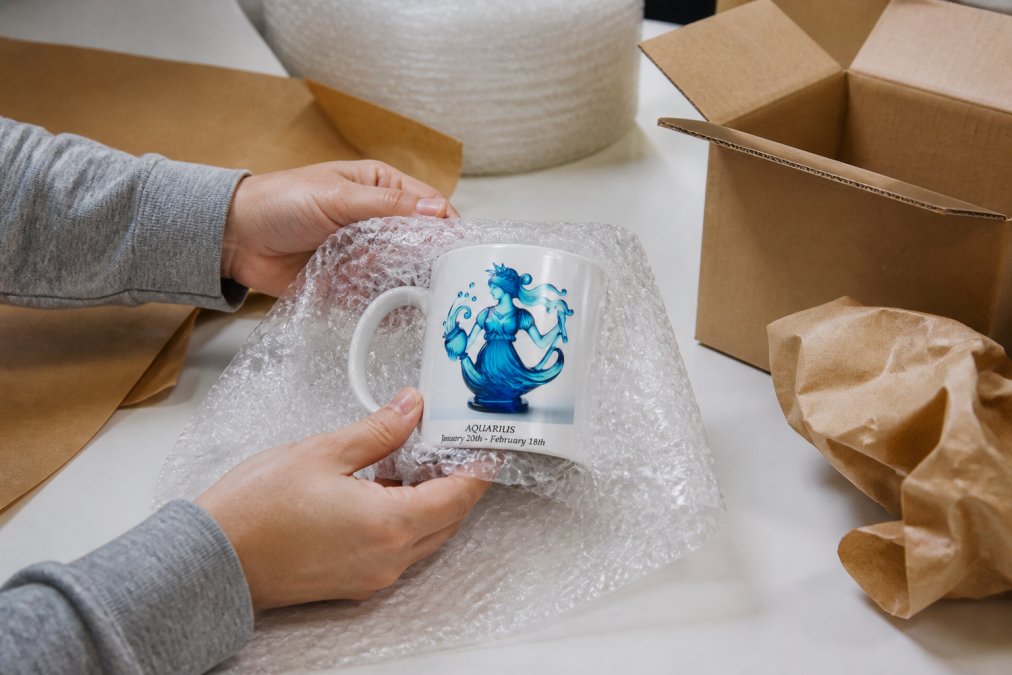
Start by wrapping each mug individually in kraft paper to create a protective layer. Next, apply bubble wrap with the bubble side facing inward toward the mug. Wrap the entire mug, overlapping each layer by at least 2-3 inches, and secure with tape at the seam.
For mugs with large handle designs, wrap the handle separately to prevent pressure points at the connection. Some shippers use foam pipe insulation cut to length and wrapped around the handle for additional protection.
Step 2: Protect Mug Handles During Shipping
Handles are the most common failure point in mug shipping. They extend from the body, creating a cantilever that concentrates pressure at the connection point. During transit, lateral movement or impact can snap a handle cleanly off.
The best shipping boxes include internal dividers or compartments that keep mugs upright and separated. If your box lacks dividers, create custom protection using foam inserts or corrugated cardboard pieces. Position mugs with handles facing inward toward the center of the box, away from exterior walls. Foam corner protectors around handle bases distribute lateral pressure across a larger surface area.
Step 3: Create a Double Boxing Setup
The double boxing method is the gold standard for fragile items. This technique places a smaller box containing the wrapped mug inside a larger box with cushioning material between the two boxes.
Surround the primary box on all sides with at least 2-3 inches of cushioning material. Fill the bottom of the larger box with 3-4 inches of cushioning before placing the smaller box inside. After positioning the inner box, fill the sides and top with additional cushioning. Ensure no part of the inner box touches the outer box walls.
Double boxing increases shipping costs but dramatically reduces damage risk. For high-value custom mugs or corporate shipments, this investment pays dividends through reduced claims and customer satisfaction.
Step 4: Fill Voids and Secure the Box
Empty spaces allow boxes to shift during transit, generating impact inside the package. After positioning your mum box inside the larger box with cushioning on all sides, fill remaining gaps with packing peanuts, crumpled kraft paper, or additional bubble wrap.
Shake the box gently after filling. Contents should not shift or move. Seal all box seams with quality packing tape using at least two horizontal strips across top and bottom, plus one vertical strip down the center seam. Consider water-activated tape for the final seal, which creates a stronger bond than standard pressure-sensitive tape.
Shipping Insurance for Custom Mugs
Shipping insurance protects both you and your customer against loss or damage during transit. Most carriers offer basic coverage, but it's often limited and may not fully cover custom mugs, which include printing costs and labor.

Declared value coverage allows you to specify full replacement value. This coverage costs 1-2% of declared value for domestic shipping (usps.gov). For a mug valued at $15-20, insurance might cost $0.15-0.40 per package, minimal compared to replacement costs.
Documentation is essential for insurance claims. Take photos of the package before sealing it, showing the wrapped mug and protective materials. Keep original box and packing materials if damage is reported. Include a packing slip documenting what was shipped and its declared value. The claims process typically takes 2-4 weeks.
Labeling and Shipping Requirements
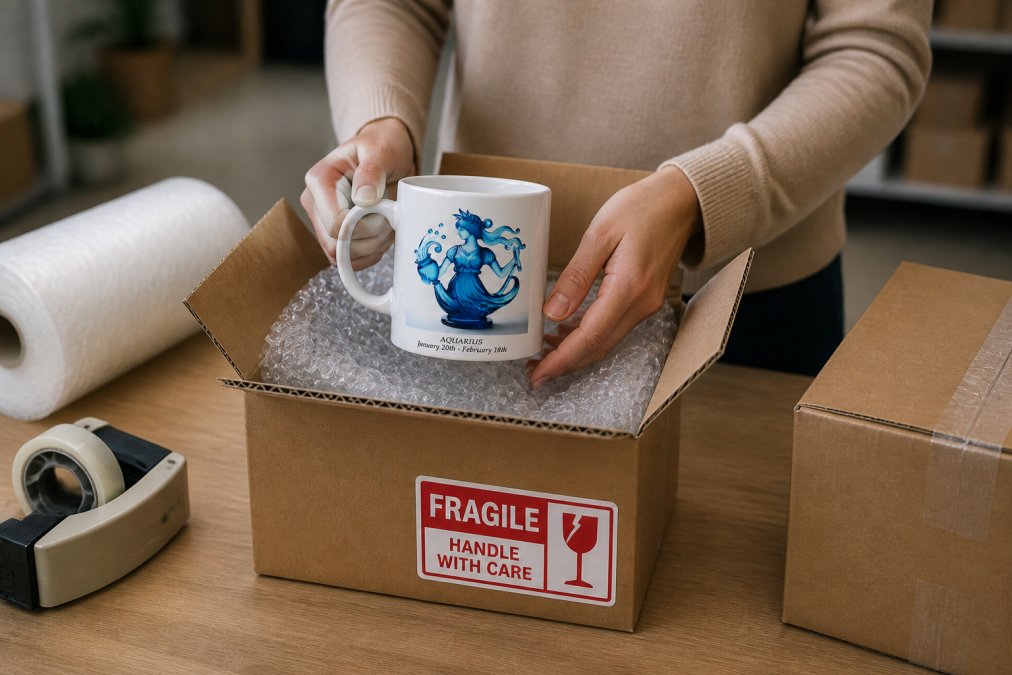
Proper labeling communicates handling requirements to everyone in the shipping chain. A "FRAGILE" label alerts handlers that contents require careful treatment. Position labels prominently on the top and at least one side of the box.
Include a "THIS SIDE UP" label if box orientation matters. For mugs in upright position, indicating correct orientation helps prevent inverted handling. Shipping labels should include complete addresses with ZIP codes and phone numbers. Double-check information before printing to prevent misdelivery.
For international shipments, include a customs declaration form with accurate description of contents and declared value. Consider adding "Handle with Care" or "Fragile Contents" text directly on the box using a marker or printed label.
Cost-Benefit Analysis of Packaging Materials
Packaging material costs vary significantly. Budget-friendly options cost $0.50-1.00 per package. Mid-range solutions cost $1.50-3.00 per package. Premium options run $3.00-5.00 per package.
Minimal packaging typically results in damage rates of 5-10% (peer-reviewed research). Adequate packaging reduces this to 1-3%. Premium packaging brings damage rates below 1%. A single damaged custom mug might cost $15-25 to replace and reship, plus customer service time and potential loss of future business. Investing $2-3 in packaging to prevent that outcome is economically rational.
Biodegradable materials have become cost-competitive with traditional options and appeal to environmentally conscious customers. Bulk purchasing of packaging materials reduces per-unit costs by 20-30% compared to smaller purchases. The most cost-effective approach combines adequate standard materials with strategic premium elements, use quality corrugated boxes and standard bubble wrap for all shipments, then add double boxing and foam inserts only for high-value orders.
Protecting your custom mugs during shipping is a core part of delivering quality. These techniques represent industry best practices proven to minimize damage and ensure mugs arrive in perfect condition. When you invest in proper packing materials and follow a systematic approach, you're protecting the experience and emotion your custom mugs represent.
At Midland Mugs, we're committed to ensuring your personalized designs arrive as beautifully as they left our workshop. Our premium ceramic mugs are crafted to last, and with the right packing strategy, they'll survive any shipping journey. Whether sending a single gift or managing bulk corporate orders, implementing these packing methods protects your investment and guarantees customer satisfaction.

Get started with Midland Mugs today and discover how our premium ceramic mugs combined with expert packing guidance creates the perfect gift-giving experience. Shop now and explore our collection of custom-printed designs that bring personality to every cup.
Frequently Asked Questions
Q: What is the safest way to pack custom mugs for shipping?
A: The safest method combines individual wrapping, protective cushioning, and double boxing. Wrap each mug in kraft paper, then bubble wrap with at least 2-3 inches of cushioning. Place wrapped mugs in a smaller box surrounded by packing peanuts or honeycomb wrap, then place that box inside a larger corrugated cardboard box with additional void fill. This layered approach absorbs impact and prevents mugs from shifting during transit, significantly reducing the risk of chips, cracks, or handle damage.
Q: Do I need double boxing to ship custom mugs?
A: Double boxing is highly recommended for custom mugs, especially valuable or personalized pieces. The box-in-a-box method creates an extra shock absorption layer that protects against vertical pressure and transit damage. For standard shipments of 1-2 mugs, a single well-padded box may suffice, but double boxing is a professional standard for ensuring parcel integrity.
Q: How do I protect mug handles during shipping?
A: Mug handles require extra reinforcement since they're the most fragile part. After wrapping the entire mug in bubble wrap, add edge protectors or extra padding specifically around the handle area. You can create a protective cage using kraft paper and additional bubble wrap layers around the handle. Some shippers use foam inserts or custom dividers to keep handles separated from other mugs. This targeted handle reinforcement is critical for preventing breakage and protecting your investment in custom-printed designs.
Q: What packing materials work best for shipping mugs?
A: Combine multiple materials for optimal protection: bubble wrap provides shock absorption, kraft paper offers a protective layer, honeycomb wrap adds cushioning density without excessive weight, and packing peanuts fill voids effectively. For eco-conscious shipping, biodegradable packing peanuts or recycled paper work well. Corrugated cardboard boxes provide structural support. The combination of these materials, bubble wrap for direct contact, kraft paper for a barrier, and void fill materials, creates secure packaging that meets shipping carrier standards and reduces dimensional weight charges.
This article was written using GrandRanker