
Durable Custom Mugs for Daily Use: A 2026 Review
Table of Contents
- Why Daily Use Demands More From a Custom Mug
- The Best Material for Coffee Mugs: Ceramic vs. Stainless Steel
- Are Dishwasher Safe Custom Mugs Actually Built to Last?
- Top Picks: Durable Custom Mugs for Every Routine
- Customisation Options That Hold Up Over Time
- Long-Term Durability and Material-Specific Care
- Frequently Asked Questions
Last Updated: September 10, 2026
Why Daily Use Demands More From a Custom Mug
A custom mug that lives in a cupboard is a different object from one that faces a dishwasher cycle every morning. Durable custom mugs for daily use must survive heat, detergent, stacking, and the small collisions of a busy kitchen. Most fading complaints trace back to the print method, not the design.
Many cheap custom mugs are decorated with a surface transfer that sits on top of the glaze rather than bonding with it. Those prints look sharp on day one and cloudy by month three. According to guidance from the U.S. Food and Drug Administration on food-contact materials, glazes and decorations on drinkware must be formulated so they don't leach into hot liquids, which is one reason reputable ceramic suppliers pay close attention to what goes onto a mug's surface. The practical takeaway: ask how the print is applied before you ask how it looks.
Below, we break down material choices, dishwasher realities, and the mugs that hold up best.
The Best Material for Coffee Mugs: Ceramic vs. Stainless Steel
The best material for coffee mugs depends on where the mug lives. Ceramic wins for home and office desks: heavy enough to stay put, retains heat well, and gives a smooth surface for full-colour printing. Stainless steel wins for commuting, because vacuum insulation keeps drinks hot for hours and the body won't shatter.
Here's how the two compare on the things that actually matter:
| Factor | Ceramic | Stainless Steel |
|---|---|---|
| Heat retention | Moderate, warms the hand | High, insulated double wall |
| Print durability | Excellent with proper firing | Good, but can scratch |
| Dishwasher safe | Yes, most glazed mugs | Usually hand wash recommended |
| Microwave safe | Yes | No, never |
| Break risk | Drops can crack it | Dents rather than shatters |
| Best for | Desk, kitchen, gifting | Travel, commuting |
For a mug that never leaves the house, ceramic is the better call: substantial, takes monogramming and photo prints beautifully, and handles thermal shock. The drawback: drop it on tile and it's gone.
The Material-Specific Care Guide Most Buying Guides Skip
Generic advice like "hand wash to be safe" is useless because ceramic and stainless steel fail in completely different ways. Here's what actually extends each material's life.
Ceramic: protect the glaze, not just the print.
- Thermal shock is the silent killer. A mug that goes from a cold cupboard to boiling water can hairline-crack the glaze. Warm it with tap water first if you pour straight from a kettle.
- Skip the heated dry cycle. Sustained high heat accelerates glaze crazing, the fine web of cracks that lets detergent under the surface and dulls the print.
- Never stack mugs rim-to-rim. Rim contact is the top cause of chips, and a chipped rim is where detergent starts attacking the body.
- Hand wash anything with metallic gold or platinum detailing; most dishwasher detergents dull them within months.
- Keep sublimated prints out of the bottom rack where the heating element sits closest.
Stainless steel: protect the seal, not just the finish.
- Hand wash only. Sustained dishwasher heat can compromise the vacuum seal between the double walls, turning a six-hour mug into a one-hour mug (consumer.ftc.gov).
- Never microwave, even for a few seconds. The metal reflects energy and can arc.
- Dry the lid mechanism fully before storing. Trapped moisture in the gasket is where odour and mould start, and the most common reason a stainless mug gets retired early.
- Avoid abrasive scrubbers on powder-coated exteriors; steel wool strips the finish and exposes bare metal that rusts at the edges.
Ergonomics: The Daily-Use Factor Nobody Measures
Durability isn't only about materials. A mug that's uncomfortable gets shoved to the back of the cupboard, and an unused mug is the least durable mug of all. Three ergonomic details matter:
- Handle clearance. A handle that only fits two fingers forces a pinch grip, fine for a five-minute coffee and miserable for a 20oz commuter mug. Look for at least 30mm of internal clearance if you have larger hands.
- Weight distribution. A 17oz ceramic mug weighs roughly 500g empty and over 1kg full: fine at a desk, awkward on a sofa (peer-reviewed research). Stainless steel is lighter for the same capacity but transfers no heat to the hand.
- Lid design. For commuters, a screw-on lid with a silicone gasket outperforms a push-on lid every time; push-on lids pop off in a bag.
Are Dishwasher Safe Custom Mugs Actually Built to Last?
Dishwasher safe custom mugs last only when two conditions are met: the print is fused into or onto the glaze at high temperature, and the cycle stays below the point where thermal shock cracks the glaze. A properly fired ceramic decoration outlasts the mug itself.
"Dishwasher safe" describes the mug body, not necessarily the print. A mug can survive a thousand cycles while its design fades to a ghost. Check these before committing:
- The print method: sublimation and laser engraving hold up far better than surface decals
- The glaze quality: a glossy, even finish resists detergent better than a matte one
- The rim and handle: these take the most abuse, so look for a smooth, thick rim
- Lead-free and BPA-free confirmation from the supplier
- Whether the mug is rated for both dishwasher and microwave use
If a listing mentions only "dishwasher safe" without saying anything about the print, treat that as a yellow flag. Ask directly.
Top Picks: Durable Custom Mugs for Every Routine
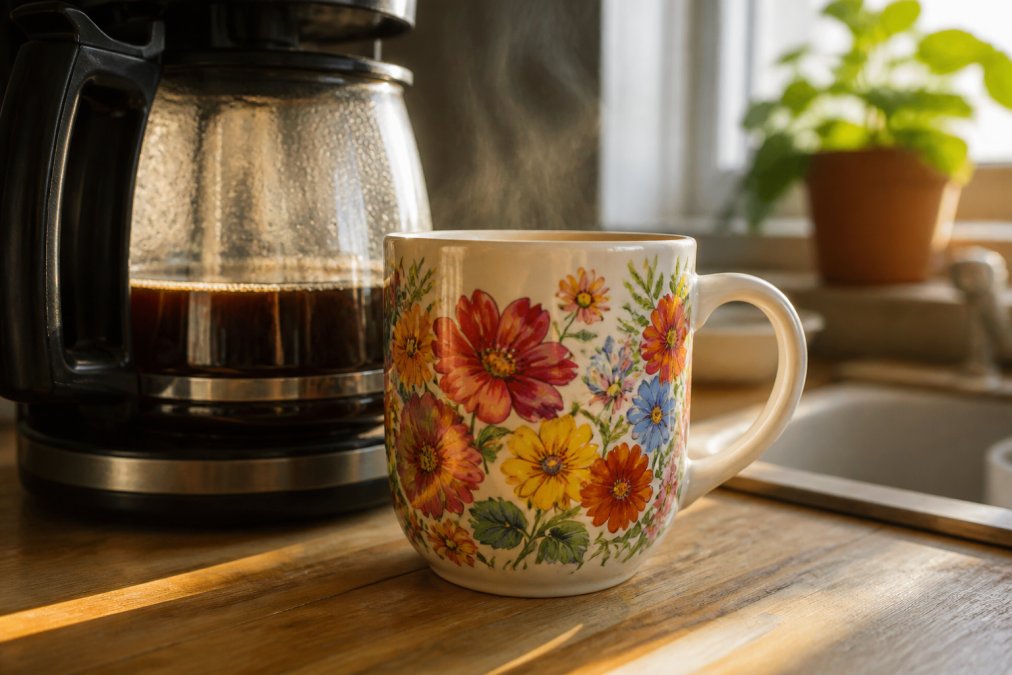
The mugs below cover the three routines that matter most: the everyday desk mug, the high-capacity drinker, and the decorative gift that still gets used daily. All share premium ceramic, dishwasher-safe construction, and prints designed to stay vivid.
Midland Mugs Alphabet Mug: Personalised Durability for 9.99
The Alphabet Mug Letter A is an 11oz ceramic mug with a coloured rim, interior, and handle against a glossy white exterior, with a letter print. At 9.99, it's a great option for everyday personalisation.

Where it falls short: 11oz is a standard size, so if you drink large lattes you'll want the 17oz option below. Dimensions are 96mm high with an 80mm base, which fits most standard cup holders and desk trays.
Breve and Cappuccino Latte Mugs: 17oz Capacity for Heavy Use
The Breve Coffee Ceramic Latte Mug and the Cappuccino Coffee Ceramic Latte Mug both hold 17oz and cost 14.99: premium ceramic, glossy white finish, microwave and dishwasher safe, 150mm high with an 88mm top diameter. For anyone who drinks two cups in one sitting, this format makes sense.


The trade-off is weight: a full 17oz mug is noticeably heavier than an 11oz one, and the wider top diameter won't fit every cup holder. On a desk, though, that extra capacity means fewer refill trips.
British Flowers and Castles Collections: Art That Survives the Wash
Decorative mugs usually fail the daily-use test. These two don't. The British Flowers Ceramic Coffee Mug Collection and the British Castles Collection Ceramic Coffee Mug are both 11oz, 9.99, with vivid prints that stay crisp after repeated microwave and dishwasher cycles.
If you're buying for a gardener, a history enthusiast, or anyone who notices detail, these hold up as gifts that actually get used.
Customisation Options That Hold Up Over Time
Customisation that lasts comes down to the printing technique, not the artwork. Three methods dominate personalised drinkware.
Sublimation uses heat to convert solid dye into gas that bonds with a polymer coating on the mug surface, producing full-colour, edge-to-edge prints that resist fading and scratching. It's behind most photo mugs and all-over designs.
Laser engraving removes a thin layer of glaze to reveal the ceramic beneath, creating a permanent, tactile mark that can never fade. It's monochrome, ideal for monograms, dates, and simple logos.
Screen printing applies ceramic ink through a mesh stencil, then fires it at high temperature. It's the standard for corporate gifting runs and produces bold, durable single-colour designs.
| Technique | Best For | Colour Range | Durability |
|---|---|---|---|
| Sublimation | Photo mugs, full-colour art | Unlimited | High |
| Laser engraving | Monograms, dates, logos | Single tone | Permanent |
| Screen printing | Bulk corporate orders | 1-4 colours | High |
For corporate gifting, screen printing remains a cost-effective route at volume, which is why the Be Consistent Team Building Message Mug is a great option for team gifts. For bespoke designs, ask for a proof before the full run.
The 100-Wash Reality Check: How Each Print Method Actually Ages
Here's how the three techniques behave across a simulated 100-cycle dishwasher life.
Sublimation (100 washes): The print stays vivid because the dye sits below the surface coating, not on top of it. The failure mode isn't fading but the polymer coating itself: a heavy-duty cycle with high-heat dry can micro-scratch it and leave it slightly hazy. Hand washing or a normal cycle with air dry can help keep a sublimated print looking new.
Laser engraving (100 washes): Effectively unchanged. Because the mark is a physical removal of glaze, there is nothing to fade. The engraved area can pick up coffee oils and darken slightly, which most people find attractive rather than a defect. It's a safe choice for a mug that maintains its appearance over time.
Screen printing (100 washes): Holds up very well when fired correctly. The risk is under-fired screen print, which looks identical on arrival but starts flaking at the edges around wash 30-40. The tell is a print that feels slightly raised or has a visible edge under a fingernail. Properly fired ceramic ink sits flush with the glaze and survives 100 cycles with minor gloss loss.
Surface decals and vinyl transfers (100 washes): Avoid these for daily use. They sit on top of the glaze and typically show edge lifting by wash 20, colour clouding by wash 50, and partial peeling by wash 100. Fine for a shelf; wrong for a mug that faces a dishwasher every morning.
How to Test a Mug's Print Before You Commit to a Set
You don't need a lab to sanity-check a print method. Three quick checks tell you more than any listing:
- The fingernail test. Drag a fingernail across the print. If it catches on an edge, it's a surface transfer. If it glides smoothly into the glaze, it's fired or sublimated.
- The hot water test. Pour boiling water in and let it sit two minutes. A cheap decal sometimes lifts at the edges when the glaze expands; a properly bonded print won't move.
- The dishwasher trial. Before ordering a full set, run one mug through 10 hot cycles with your normal detergent to see the first signs of clouding or edge lift.
Long-Term Durability and Material-Specific Care
Long-term durability is mostly about care habits, and ceramic and stainless steel need different treatment. A few consistent practices keep any custom mug looking new.
Ceramic care:
- Wash on a normal cycle, but skip the heated dry setting if your dishwasher has one
- Avoid stacking mugs directly inside each other, since rim-to-rim contact causes chips
- Don't pour boiling water into a mug straight from a cold cupboard; gradual temperature change protects the glaze
- Hand wash any mug with metallic detailing, since detergents dull gold and silver accents
Stainless steel care:
- Hand wash to protect the vacuum seal and exterior coating
- Never microwave a stainless mug
- Dry fully before storing to prevent water spots inside the lid mechanism
The single biggest killer of ceramic mugs isn't the dishwasher. It's the sink: mugs knocked against each other while drying chip at the rim far more often than they fade. A drying rack with individual slots solves most of it.
Choosing durable custom mugs for daily use comes down to matching the mug to how you drink, then checking the print method can survive your dishwasher. Most fading complaints come from surface transfers, not ceramic itself.
Midland Mugs builds every mug on premium ceramic with dishwasher-safe, microwave-safe construction and prints designed to stay vivid wash after wash. Whether you need a 9.99 personalised alphabet mug, a 17oz latte mug for heavy use, or a full set of branded drinkware for your team, the collection covers it, with fast shipping and secure packaging on every order. Shop now and pick the mug that fits your routine.
Frequently Asked Questions
Who makes the best custom mugs for daily use?
Midland Mugs offers a range of durable custom mugs designed for daily use, including 11oz and 17oz ceramic options. Their mugs feature high-quality prints that resist fading, are dishwasher and microwave safe, and come in designs like the Alphabet Mug or British Flowers Collection. Starting at 9.99, they balance durability with personalisation for gifts or office use.
Which coffee mug is the most durable?
Ceramic mugs with a glossy finish and high-quality print, like Midland Mugs' 11oz and 17oz options, are highly durable for daily use. They resist chipping and fading when cared for properly. Stainless steel is also durable but can affect flavour. For many coffee drinkers, a well-made ceramic mug offers a good combination of heat retention, feel, and print longevity.
Are dishwasher safe custom mugs really safe to wash in a dishwasher?
Yes, Midland Mugs' dishwasher safe custom mugs are tested to withstand repeated dishwasher cycles without the print fading or peeling. The high-quality ceramic and print process ensure the design stays vibrant. For best results, place mugs on the top rack and avoid harsh detergents. This makes them practical for everyday use at home or in the office.
How much should a custom mug cost?
Custom mug prices vary based on material, print method, and quantity. Midland Mugs' ceramic mugs start at 9.99 for 11oz designs and 14.99 for 17oz latte mugs. These prices reflect premium ceramic and durable printing. Bulk orders may offer additional savings. Investing in quality can help ensure the print and mug last through daily use.
Are ceramic mugs better than stainless steel for daily use?
Ceramic mugs are often better for daily coffee or tea because they don't retain flavours or odours and feel comfortable to hold. Stainless steel is more shatter-resistant but can alter taste and isn't microwave safe. Midland Mugs' ceramic options are dishwasher and microwave safe, making them a practical choice for everyday routines.